
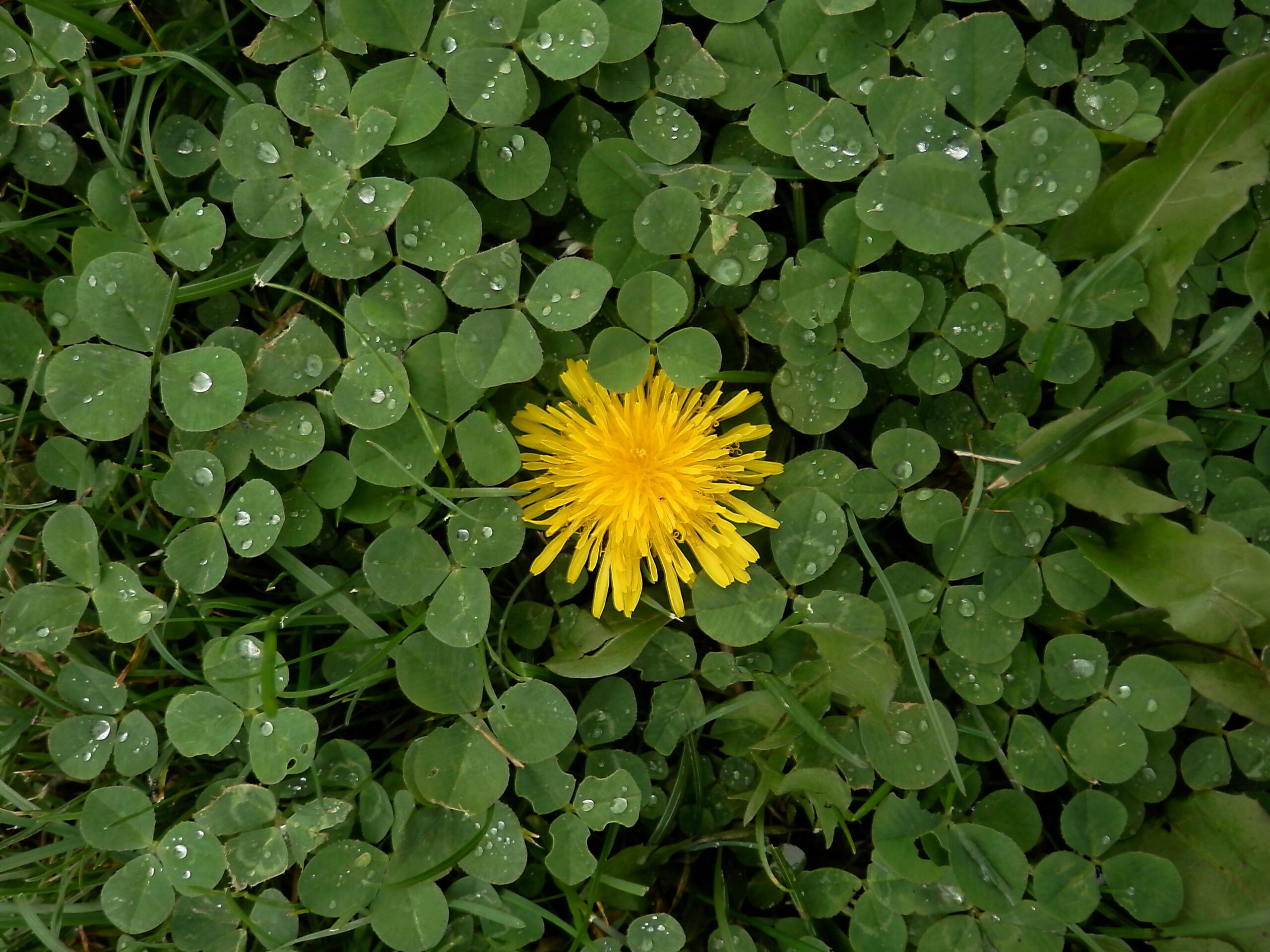
What clover, dandelions, and an unexpected soil test discovery taught me about looking a little closer.
Apparently, the east side of my lawn has its own landscaping plans.
Nobody consulted me.
The clover is flourishing. The dandelions have made themselves comfortable. And the grass, which was theoretically supposed to be the main attraction, has agreed to share the stage.
I could look at this situation and declare war on the weeds.
But I’ve been wondering about something else.
Why are the clover and dandelions so happy in this particular patch of ground?
After all, they’re not growing there to annoy me. They have no idea what a lawn is supposed to look like.
They’re simply taking advantage of conditions that suit them.
Which raises an interesting question: What might these unwanted guests tell me about my yard?
Who Decided It Was a Weed?
Gardening has some peculiar rules.
We purchase plants, carefully arrange them in beds, water them, fertilize them, and occasionally struggle to keep them alive.
Meanwhile, a dandelion establishes itself in a crack in the driveway without any assistance whatsoever.
And somehow, the dandelion is the problem.
The word weed often tells us more about our preferences than about the plant itself.
A violet growing in a woodland garden might be delightful. The same violet appearing in someone’s carefully maintained lawn could be considered unwelcome.
Same plant. Different expectations.
Gardeners also use the term volunteer plant to describe a plant that appears on its own, without being deliberately planted. Perhaps a bird deposited a seed, the wind carried one into the garden, or an old seed finally found the right conditions to germinate.
Some volunteers are welcome surprises. Others are decidedly less welcome.
And being a volunteer doesn’t automatically make a plant native, beneficial, or harmless. Some plants are invasive, some spread aggressively, and others interfere with what we’re trying to grow.
But before we reach for the trowel or decide something needs to go, perhaps we should ask:
Why is this plant succeeding here?
Because sometimes, the plants we didn’t invite are the ones worth investigating.
Your Weeds May Know Something You Don’t
Certain plants are associated with particular growing conditions. Gardeners sometimes call them indicator plants or indicator weeds.
Their presence can offer clues about soil, moisture, sunlight, or disturbance.
Think of them as potential witnesses in a backyard investigation.
Useful witnesses, perhaps. But not necessarily ones who know the whole story.
Clover: A Clue About Nitrogen?
White clover has an interesting advantage.
Like other legumes, it can form partnerships with bacteria in its roots that convert atmospheric nitrogen into a form the plant can use.
That’s particularly useful when available soil nitrogen is limited.
Turfgrass doesn’t have this same ability, so clover may compete successfully in some low-nitrogen lawns.
Does that mean a lawn full of clover is definitely nitrogen-deficient?
Not necessarily.
Clover also tolerates close mowing, spreads through creeping stems, and can thrive in soils with adequate fertility.
It’s a clue, not a diagnosis.
Dandelions: Masters of Opportunity
Dandelions are remarkably adaptable.
Their wind-dispersed seeds travel readily, their substantial taproots help established plants survive, and they can take advantage of openings where turfgrass is thin.
They can also tolerate compacted soil, although finding dandelions doesn’t prove that compaction is present.
Perhaps the surrounding grass isn’t competing well. Perhaps conditions favor the dandelions. Or perhaps their seeds simply found a convenient place to land.
The dandelion isn’t necessarily revealing a problem.
It may simply be demonstrating how well it can survive.
Plantain: Worth a Closer Look
Broadleaf plantain often appears in compacted or heavily traveled ground.
If you repeatedly notice it along a walking route or in an area that receives considerable foot traffic, compaction might be worth investigating.
But the presence of plantain alone isn’t proof.
The same principle applies to other plants associated with wet soil, disturbed ground, shade, or poor growing conditions.
A weed isn’t a soil test. It’s a reason to ask another question.
Meanwhile, back on the East Side of My House…
Armed with this perspective, I turned my attention to my clover-and-dandelion situation.
Why the east side?
Perhaps the soil is different. Perhaps morning sunshine and afternoon shade play a role. Maybe moisture, mowing, or the condition of the turfgrass itself provides an advantage.
Fortunately, I had something more informative than speculation.
An actual soil test.
I’d previously tested a lawn area on that same side of the house. It wasn’t the exact patch where the clover and dandelions are concentrated, so I couldn’t assume the results represented every square foot.
Still, it was a useful place to start.
And the results were interesting.
My soil had a pH of 5.6, making it acidic. The test also reported below-optimum phosphorus and calcium, while magnesium and potassium were within the laboratory’s optimum ranges.
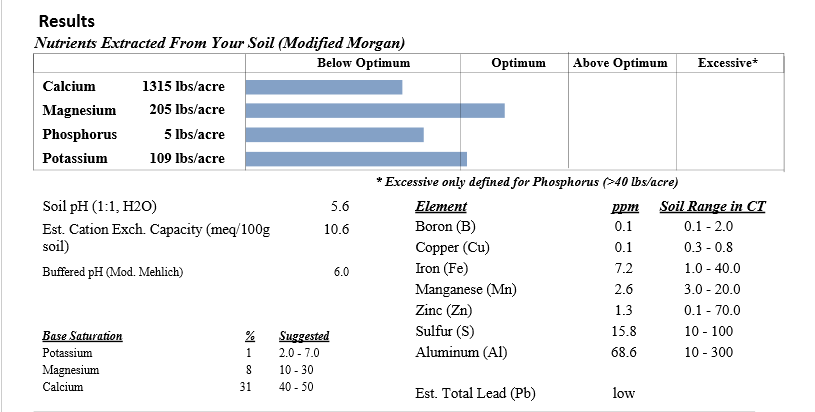
Soil pH influences nutrient availability, and many common lawn grasses prefer conditions somewhat less acidic than those indicated by my test.
Perhaps I was getting somewhere.
Then I remembered clover’s relationship with nitrogen.
Naturally, I went looking for the nitrogen result.
There wasn’t one.
The nutrient I was particularly curious about hadn’t even been measured.
As it turns out, that’s normal. Routine soil tests generally don’t measure nitrogen because plant-available nitrogen levels fluctuate considerably with weather, soil microorganisms, and plant activity.
So I had some genuinely useful information, but not a complete explanation for what was happening in my lawn.
Which, frankly, is often how gardening works.
You begin with one question and end up with several more.
We’ve Made Some Changes. Now We Wait.
After receiving our soil test results, we applied lime and fertilizer and aerated the lawn.
When recommended for the conditions present, lime can help raise soil pH, fertilizer supplies nutrients, and aeration can help address certain soil compaction problems.
Will these changes help the grass grow more vigorously?
Possibly.
Will the clover and dandelions become less abundant?
We’ll see.
Even if the grass improves next spring, we won’t necessarily know which treatment contributed most to the change. And clover and dandelions can coexist with healthy turfgrass.
That’s worth remembering. Not every plant growing in a lawn represents a problem that needs correcting.
For now, we’ve made our changes.
The plants have declined to comment.
A Little Backyard Detective Work
You don’t need a horticulture degree to investigate what’s growing in your own yard.
Start by noticing patterns.
Does a particular plant appear mostly where people walk? In a damp corner? Beneath a tree? Along a sunny driveway? In places where the grass seems to struggle?
Then look at the surrounding conditions.
Consider sunlight, moisture, drainage, foot traffic, mowing practices, soil disturbance, and competition from other plants.
If you suspect a nutrient or pH issue, a soil test from the relevant area can help. Guessing based solely on which weeds are present is much less reliable.
For Connecticut gardeners: The University of Connecticut Soil Nutrient Analysis Laboratory offers soil testing for lawns, gardens, and landscapes. The laboratory provides sampling instructions, submission information, and research-based recommendations to help you understand your results before making changes.
And remember that not every volunteer plant needs to be removed.
Sometimes a plant is genuinely troublesome. Sometimes it provides something useful. Sometimes it’s simply growing in a place where we didn’t expect it.
The first step is figuring out what you’re looking at.
The second is deciding whether anything actually needs to change.
To Be Continued… In Spring
Next spring, I’ll revisit the east side of my lawn.
Will the grass be thicker? Will the clover be less abundant? Will the dandelions return as though nothing happened?
I don’t know yet.
I plan to look at the same area, compare what has changed, and see whether our efforts produced a noticeable difference.
The results might support some of my suspicions.
They might contradict them.
They might raise entirely new questions.
And that’s part of what makes gardening interesting.
A garden isn’t simply a collection of plants arranged according to our instructions. It’s a living place where soil, sunlight, water, organisms, and time are constantly interacting.
We get to participate.
We don’t get to control every outcome.
And sometimes the most interesting thing growing in the garden isn’t the plant we intended to put there.
It’s the one that makes us stop and wonder why.
Come Curious. 🦉
Stay Curious.
Enjoy discovering the unexpected in everyday nature? Join the Onyx & Owl newsletter for curious discoveries, practical gardening insights, and a fresh perspective on the world just outside your door.
Sources and further reading
UConn Extension — Indicator Weeds: Turf
UConn — Interpretation of Soil Test Results
UMass Extension — Weed Management
UConn Soil Nutrient Analysis Laboratory
Featured photograph: Ryan Hodnett / Wikimedia Commons, CC BY-SA 4.0.
